
September 9, 2026
Why I Started the Swarthy Channel.
I did not grow up wanting to challenge history.
I grew up loving it.
Seventh grade. Orange Middle School. Orange, New Jersey.
A history teacher named Mr. Arnold at the front of the room, doing whatever it is great teachers do, the thing you can’t quite name, but that changes something in you permanently.
He made the past feel like it was still happening.
Before his class, history was something that happened a long time ago.
After his class, it felt alive.
Kings rose and fell. Armies crossed mountains.
Empires disappeared. Libraries burned.
Entire civilizations left pieces of themselves behind, waiting for someone curious enough to find them.
History became more than dates and names.
It became a story worth chasing, and before I knew it, I developed a passion for history.
And that love has never left me.
But as I read more, I began noticing something that I could not ignore.
When I opened the textbooks, I rarely found people who looked like me.
Not as kings. Not as queens.
Not as philosophers, explorers, inventors, warriors, or builders of civilization.
Black history seemed to begin and end with slavery.
Africa was presented as if it existed outside the great movements of the ancient world.
Europe appeared almost entirely devoid of any color, not merely in modern illustrations, but in our collective imagination.
That absence stayed with me.
The Saying I Refused to Accept.
Growing up, I often heard a painful saying:
“If you want to hide something from a Black man, put it in a book.”
I never wanted that statement to apply to me.
So, I went to the library.
I read old books, new books, forgotten books, books written by people who had been dead so long that their names were spelled three different ways depending on the century.
Biographies, religious texts, historical accounts, and whatever else led me further down the road.
I followed footnotes. I compared descriptions. I studied coins, statues, maps, names, bloodlines, and eyewitness accounts, tracing citations backward, comparing what one witness said in 100 AD to what a “summary” said in 1850.
I was not searching for fantasy.
I was searching for what was in the primary accounts but had been left out.
What I found changed the way I understood history.
Faces on original coins did not always resemble the modern portraits presented in textbooks.
Names, dynasties, warriors, scholars were edited out of the story a piece at a time, until the version we all inherited was the only version that felt “normal.”
People once described as dark, swarthy, brown, or Black were gradually repainted, reclassified, or separated from the descendants who might recognize themselves in them.
Names changed. Definitions changed. Portraits changed.
And sometimes, the people themselves seemed to disappear.
Yet the evidence had not vanished completely.
Much of it was still sitting on open shelves.
The Libraries Were My First Archive.
I grew up in public libraries, pulling books from shelves and following one discovery into another.
That experience shaped me deeply.
It taught me that history is rarely hidden in one locked room.
More often, it is fragmented.
One piece survives in a book.
Another appears on a coin.
Another remains inside an old translation.
Another is preserved in an eyewitness description that later historians stopped repeating.
The full picture emerges only when someone cares enough to bring the fragments back together.
I also came to appreciate something extraordinary about this country: the books were available.
The archives were public. The libraries were free.
America is not perfect, but curiosity is not a crime here.
I had the freedom to read, question, compare, and reach my own conclusions.
The Swarthy Channel was born from that freedom.
Why “Swarthy”?
The word swarthy itself is a small door into a big room.
The word “swarthy” appears throughout historical literature.
It was used to describe people with dark, brown, sun-browned, or Black complexions.
When historical writers described a Roman emperor, Germanic king, Norse seafarer, or Greek philosopher as “swarthy”, dark-complected, sun-browned, or dusky, they weren’t reaching for metaphor.
They were describing physical appearance.
Statues survive. Coins survive. Court records survive.
So do the eyewitnesses.
Somewhere between then and now, that word got quietly reclassified. Softened. Rewritten. And with it, entire bloodlines got repainted.
I’m not the first person to notice this.
I’m not the first to write about it.
But I did decide I would be one of the people who made it watchable, because a paragraph in a scholarly journal reaches a few hundred people, and a well-made short reaches a few million.
So, here’s the standard I try to hold to on every episode:
Primary sources first.
Herodotus, Diodorus, Tacitus, Ibn Fadlan and others.
Digitized old books. The ancient coin in the museum case.
The statue or portrait they didn’t destroy or repaint.
History was not always as visually simple as it is presented today.
Populations moved. Empires mixed. Dynasties intermarried.
Armies carried people across deserts and continents.
Merchants crossed seas.
Africans, Indigenous peoples, and other dark-complexioned populations lived, ruled, fought, studied, and built far beyond the borders modern audiences associate with them.
The Swarthy Channel explores those complicated spaces.
We investigate forgotten rulers, erased bloodlines, Black and dark-complexioned people in the ancient and medieval worlds, sacred knowledge, lost civilizations, and historical evidence that challenges familiar portraits.
They taught us to imagine Europe’s rulers as uniformly fair-skinned.
But many surviving coins, statues, and eyewitness descriptions complicate that picture.
Why This History Matters.
Memory is infrastructure. It supports what we believe about ourselves.
When a people’s history is erased, the damage extends beyond missing names and dates.
Their understanding of themselves is reshaped.
Their self-perception is diminished.
Their future becomes narrower.
If generations of children never see people who resemble them presented as builders, rulers, navigators, scholars, scientists, and creators, they may unconsciously begin to believe those roles belong to someone else.
Perception becomes reality.
What people believe about their past influences what they believe is possible in their future.
That is why this work matters to me.
I don’t say that to provoke anyone. I say it because I lived it.
The Swarthy Channel is not built around anger or bitterness.
It is not about replacing one false history with another.
It is not an excuse to invent comforting stories.
It is about restoring historical evidence to the conversation.
Primary accounts. Original images. Coins. Statues. Inscriptions.
Old Books. Archaeology.
The words of people who lived closer to the time being discussed.
Our audience does not have to accept every interpretation.
I want people to become curious enough to investigate for themselves.
The Swarthy Channel is my way of saying: the archive is open.
The libraries are free. The coins are still in the museums.
The eyewitnesses are still on the page; you just have to find them.
AI Changed What Was Possible.
For most of my life, I carried these stories in my mind.
I could research them. I could explain them to my friends.
I could imagine what they might look like on screen.
But imagination and production were separated by money, technology, access, and entire teams of people.
Traditionally, bringing the ancient world to life required studios, actors, costume designers, set builders, visual-effects artists, editors, and enormous budgets.
Then generative AI arrived.
Suddenly, a person with an idea could begin building what once required an institution.
I realized that I could do more than talk and post images about history.
I could make people feel it.
I could place viewers inside ancient temples.
I could reconstruct forgotten kings from surviving evidence.
I could show civilizations moving, breathing, fighting, worshipping, building, and remembering.
I could transform research into cinematic historical storytelling.
But technology did not do this by itself.
I spent more than a year and a half in the lab learning how to use it, testing tools, studying prompts, correcting mistakes, improving historical details, refining images, creating motion, editing scenes, and developing a visual language for The Swarthy Channel.
AI did not give me the vision.
The vision had been forming since seventh grade.
AI gave me the means to manifest it.
For the Idea Guys and Gals.
For decades, people with powerful ideas were dismissed because they lacked the resources to execute them.
They were told:
“You need a team.” “You need investors.” “You need a studio.”
“You need permission.”
They were called dreamers as though dreaming were a defect.
I understand those people because I am one of them.
The Swarthy Channel is evidence that the distance between imagination and creation is shrinking.
One determined person can now research, write, narrate, design, animate, edit, publish, and distribute an original body of work.
That does not make the process easy.
It makes the process possible.
AI is not a substitute for curiosity, knowledge, discipline, taste, or judgment.
It cannot care about the story. It cannot give you a reason to create.
But when those qualities are already inside you, AI can become a force multiplier.
It can help an idea escape from your imagination and enter the world.
More Than a Content Channel.
I do not see The Swarthy Channel as another social-media page.
I see it as a living archive.
A temple entrance into forgotten and erased memory.
Entertainment opens the door. Historical evidence walks in behind it.
Every episode is another recovered fragment.
Every documentary adds another room to the archive.
Every discussion encourages someone to open a book, inspect a coin, question a portrait, or follow a footnote.
The archive is not finished. It never will be.
There will always be another ruler to rediscover, another account to examine, another image to question, and another civilization waiting to be seen with fresh eyes.
My vision extends beyond short videos.
I see longer films, documentaries, books, interactive historical experiences, educational programs, and an independent platform where these stories can live without being diluted for an algorithm.
This is only the beginning.
To Everyone Who Helped Make This Real.
To everyone who watched an episode, left a comment, challenged an idea, shared a video, subscribed, or told someone else about The Swarthy Channel: Thank You!
You helped me turn something that lived inside my mind into something real.
You proved that an audience exists for history that is cinematic, provocative, evidence-driven, and unafraid to revisit what we think we know.
Most importantly, you proved that I was not the only person who felt something was missing.
If you found this channel, perhaps you felt it too.
You noticed the gaps. You questioned the portraits.
You sensed that the human story was richer, darker, stranger, and more interconnected than the version many of us received.
You did not arrive here by accident.
You arrived because history left something out and you felt it.
The Swarthy Channel exists to find those missing pieces and return them to the conversation.
The ancient world awakens.
Forgotten empires. Erased rulers. Untold history.
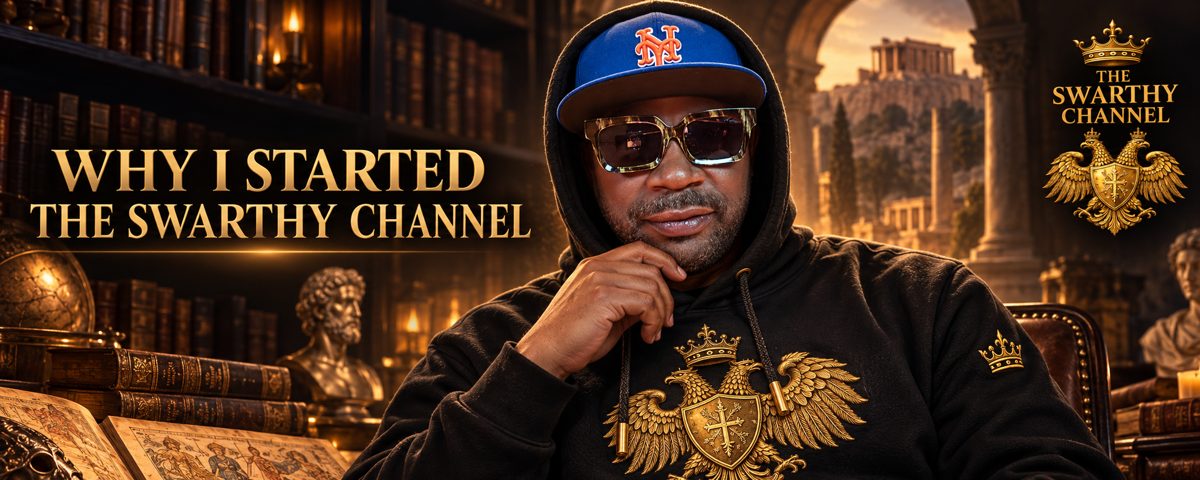
This is The Swarthy Channel!
If this work matters to you, join the $1 Swarthy Circle. One dollar a month keeps this channel independent. Join on Patreon
Get the next issue